
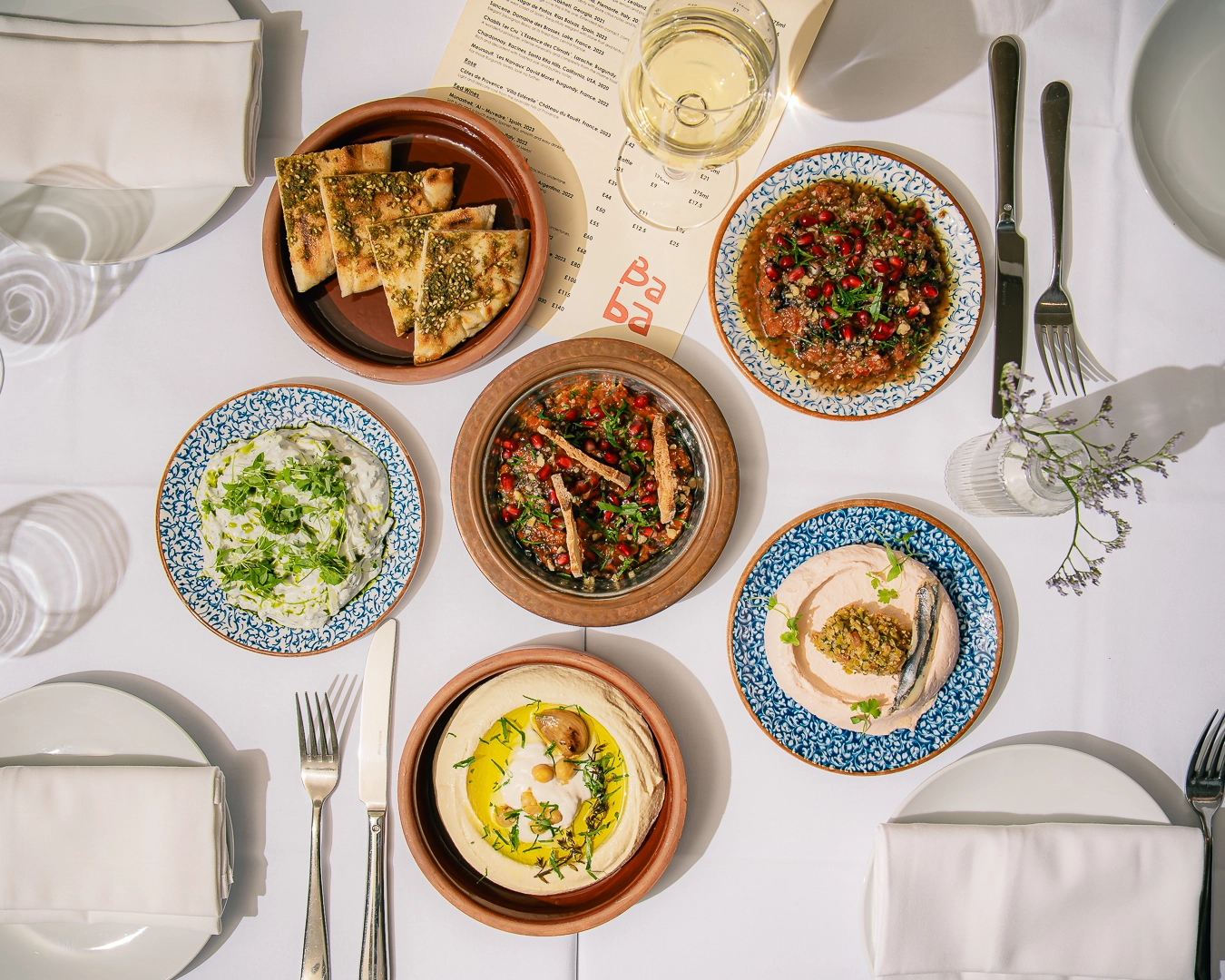
If you’ve ever sat down at a Turkish restaurant and wondered why the table next to you seems to have ordered half the menu, this guide is for you. A Turkish meal is rarely one plate each. It’s a spread of small dishes, passed around and topped up, with the main course coming later, if anyone still has room.
At Baba, our modern Turkish restaurant in Chelsea, plenty of guests are trying Turkish food for the first time. So here’s a simple guide to meze: what it is, how to order it, and the dishes worth knowing before you sit down.
What is meze?
Meze (say “meh-zeh”) are small plates served at the start of a meal for the whole table to share. Some are cold, like dips, salads and vegetables cooked in olive oil. Others are hot, like dumplings, seafood or fried pastries.
Meze isn’t quite a starter in the British sense. It’s the part of the meal where people settle in, talk and eat slowly. In Turkey, an evening of meze with friends can easily last a few hours, and some tables never get round to a main course at all.
Bread matters too. Most cold meze is eaten by scooping it up with bread rather than with a knife and fork, so don’t be shy about it.
Cold meze: the easiest place to start
Cold meze is the simplest way in. These are the dishes you’ll find on almost every Turkish table.
- Hummus. Chickpeas blended with tahini, lemon and garlic. Most people already know it, which makes it a safe first order.
- Cacık. Yoghurt with cucumber, garlic and mint. It’s close to Greek tzatziki, but usually looser and more herby. We add dill to ours.
- Babagannuş. Smoked aubergine mixed with tahini. Aubergine turns up everywhere in Turkish cooking, and smoking it gives this dip a deep, rich flavour.
- Muhammara. A dip made with smoked red peppers. It’s slightly sweet with a gentle heat. It’s traditionally made with walnuts, so mention any nut allergy when you order.
- Yaprak sarma. Vine leaves wrapped around seasoned rice. They’re small, but often the first plate to disappear.
- Çoban salad. The “shepherd’s salad” of chopped tomato, cucumber, onion, pepper and parsley. It’s fresh and sharp, and it works well next to richer dishes.
For two people, three cold meze is a good start. You can always add more.
Hot meze worth sharing
Once the cold plates are down, a hot meze or two adds warmth and contrast.
İçli köfte. The name means “stuffed köfte”. A thin shell of bulgur or semolina is wrapped around spiced minced meat and shaped by hand. Making them well takes patience, which is why many people save them for a restaurant. Ours are made with semolina and beef, and served with garlic yoghurt and Aleppo chilli oil.
Octopus. Seafood meze is part of everyday eating along Turkey’s Aegean coast. We braise our octopus and serve it with a sauce made with urfa isot, a dark, smoky Turkish chilli that’s warming rather than fiery.
Beyond meze: three Turkish classics
If you do make it to the main course, these are three dishes worth knowing.
Hünkar beğendi. The name roughly means “the sultan liked it”. Slow-cooked lamb is served on a smooth purée of smoked aubergine. The story goes that it was first made in the Ottoman palace kitchens in the 19th century, and it has stayed on Turkish menus ever since. If you only try one Turkish main, make it this one.
Köfte. Turkish meatballs, and every region, and almost every family, has its own version. Ours are made with beef and lamb, and served in tomato sauce with yoghurt and a fresh herb salad.
Lamb. Lamb sits at the heart of Turkish cooking, from slow-cooked stews to simple chops. If you’d rather keep things straightforward, our lamb chops come with a warm white bean salad and tahini dressing.
How much should you order?
A rough guide:
- Two people: three or four meze to share, then one or two mains.
- Four people: five or six meze, then two or three mains between you.
- A bigger group: order in rounds. Start with a few cold plates, see how the table is doing, then add hot meze.
Ordering in rounds is how it’s done in Turkey anyway. A good spread has something creamy, something fresh, something smoky and something hot. If you’re not sure, ask your server to put one together for the table.
Ready to try it? Book a table at Baba.
Finishing the Turkish way
A Turkish meal doesn’t end in a hurry. Dessert comes with something hot to drink, and nobody rushes you out.
- Sütlaç. Turkish rice pudding, lighter and more delicate than the British version. Ours is flavoured with vanilla and orange.
- İrmik helvası. Semolina cooked slowly in butter until golden, then sweetened and finished with pine nuts. It’s a dessert many Turks grew up with, and ours comes with ice cream.
- Turkish coffee cream pot. If you like the taste of Turkish coffee, this brings it to dessert, with a chocolate ganache.
- Turkish tea. Strong, served without milk and traditionally poured into small tulip-shaped glasses. In Turkey it’s offered at almost any hour, and it’s the natural way to close a meal.
See the full dessert menu.
Frequently asked questions
Is Turkish food good for vegetarians?
Very. Many of the best-known meze are traditionally vegetarian, including hummus, cacık, babagannuş and çoban salad, and you could easily make a full meal from meze alone. Our moussaka is made with roasted vegetables rather than meat. Let our team know about any dietary needs or allergies and they’ll guide you through the menu.
What’s the difference between cacık and tzatziki?
They’re close cousins. Both are made with yoghurt, cucumber and garlic. Turkish cacık is often looser and more herby, while tzatziki tends to be thicker and is served more as a dip.
Do I need to book?
We recommend it, especially for weekend evenings and larger groups. You can book online or call us on 07918 728588.
Come and try it
The best way to get to know meze is to order a few plates and share them. Have a look at our à la carte menu, then book a table at Baba, 212 Fulham Road, Chelsea. Planning a birthday, family meal or get-together? Our private dining page has the details.
Book a table at Baba
Modern Turkish food in Chelsea
212 Fulham Road, London SW10 9PJ · 07918 728588